
|
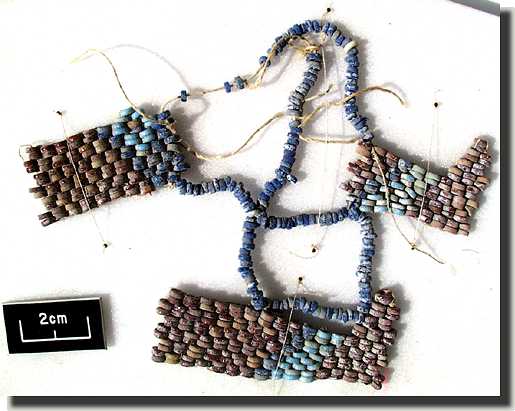
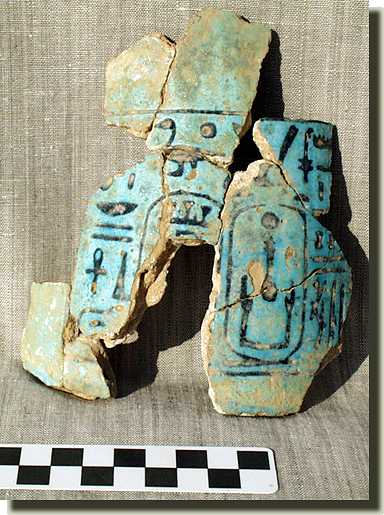
Nigel and Helen Strudwick spent the second half of the season examining objects in other categories which have been found in the excavations since 1993. The aim was to obtain an overview of the material which has been recovered, and to group and examine it with the view to preparing it for publication. The following categories cover much of what has been found; some material still remains to be studied, while others (notably shabtis) were examined in earlier seasons. 3 Burial of SenneferiThe remains of the tomb owner's burial, discovered at the bottom of the deep courtyard shaft excavated in 1998, has proved to be a closed context. Other than in the first few metres of the corridor, where material has intruded from the refilling of the shaft, nothing has been found which is not associated with the tomb-owner's burial, which assertion is confirmed by the ceramics (above). Boxes: A number of wooden boxes were identified, including parts of the sledge and base of a canopic chest. Some of the boxes were quite small and made of plain thin wood, while others were more substantial and were painted white or coated with black resin in the same manner as the coffins (which still have to be studied). Several of the boxes bore Senneferi's name and title. Furniture: one leg of a bed or similar has been found, while the existence of two braces attests the original presence of a chair or similar.
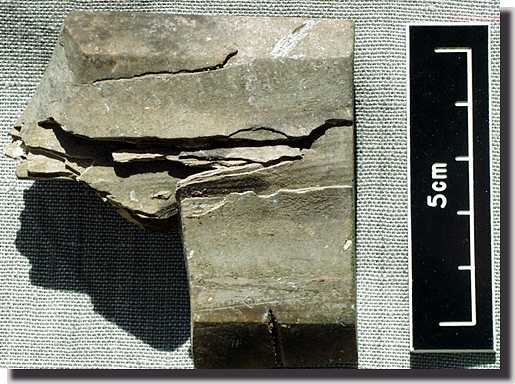
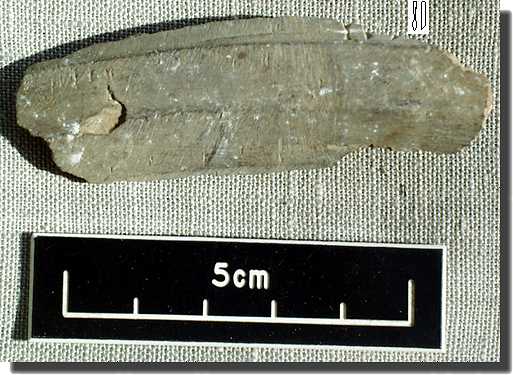
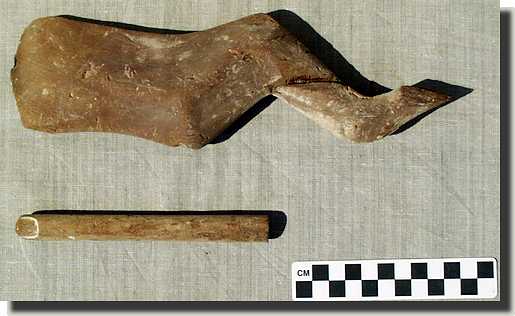
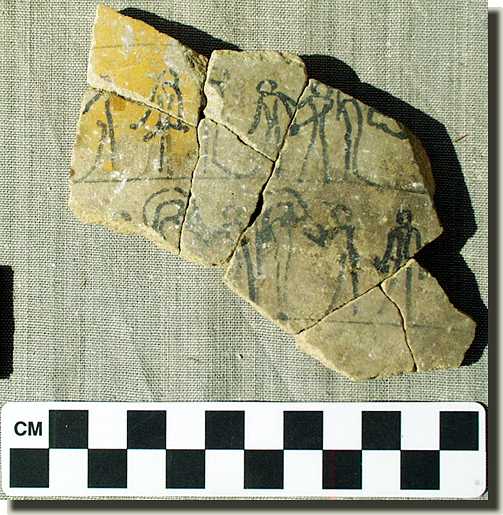
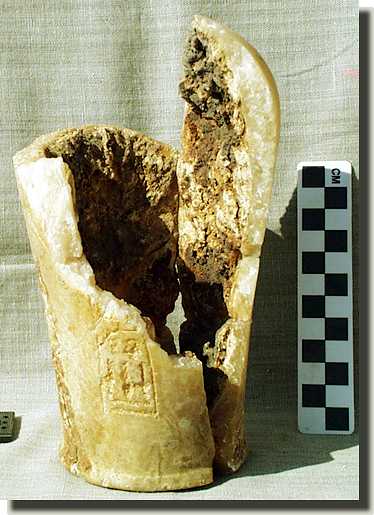
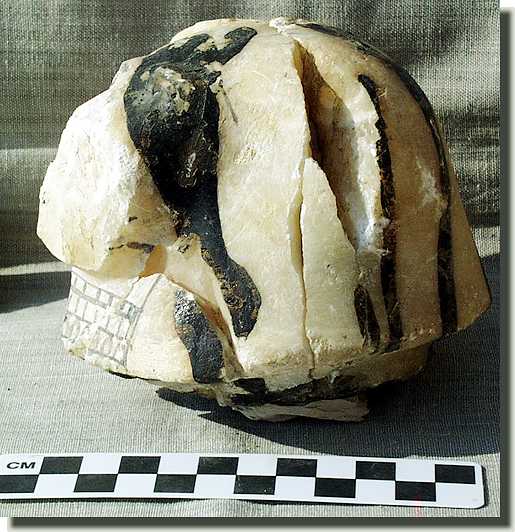
Opening of the Mouth objects: of particular interest is the identification of two strange objects, noted in the 1998 report, as parts of adzes of elephant ivory used in the Opening of the Mouth ritual (1, 2 below).5 These bear texts on one side which give their name, while on the rear curved surface is the beginning of a funerary formula, probably ending in the name of the deceased. Further objects probably also are to be associated with this ritual, notably a wooden khepesh and finger (3 below). Items of both shapes are presented to mummies in the course of the ritual, and so, like the adzes, they appear to have been part of a set of implements left in the burial chamber. An interesting item is the ostrakon shown in 4 below, also from the burial chamber of Senneferi, which seems to show a series of scenes from the same ritual; could this perhaps have functioned as a magical guide for the use of these ritual objects?
Vessel inscriptions: as noted in the ceramic report, a number of vessels from the Senneferi burial bore hieratic inscriptions in black ink. 6 These have yet to be completely examined, but as expected most seem to relate to the contents. Many vessels are marked as having contained wine, while others contained types of seeds. One vessel at least seems to have borne the date of year 25; the name of the king is not given, but in keeping with the other dating evidence for Senneferi, the reign of Thutmose III would be the most appropriate. A faint stamp with that king's throne name was noted on one amphora. Putting together this with the conclusions which can be derived from the papyri, shrouds and ceramics noted above, it is clear that the material from the burial of Senneferi will offer an unusually detailed insight into the contents of the tomb of a noble of the Thutmoside period. Third Intermediate Period burialsThe largest category of objects is coffin fragments, for which see John H. Taylor's report above. Otherwise the following are of the principal groups examined this season: Amulets: there are two main groups of these, the winged scarabs and Sons of Horus which were sewn onto bead nets, and the separate amulets placed in various strategic locations on the body. Fragments of a number of the former have survived, but only a very few of the latter; this is perhaps because they were easily stolen by tomb robbers.
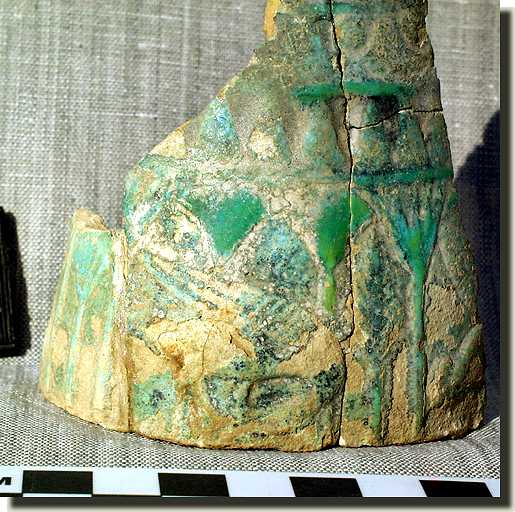
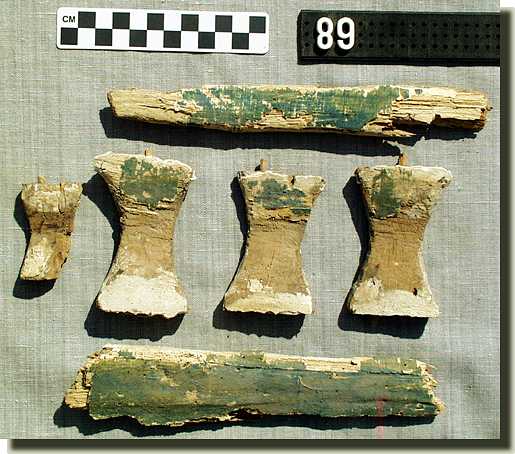
Boxes: a number of boxes of various types have been isolated. These include two shabti box lids bearing the image of a boat, typical of the later Third Intermediate Period; fragments of one or two more lids with polychrome decoration were also noted. Two larger boxes with striped decoration were also recorded, the purpose of which is not certain, although they could perhaps be an early form of the later canopic box type. Ptah-Sokar-Osiris figures: one complete such figure was found in 1994, 10 and there are a number of fragments of crowns and beards, as well as the small hawk figures which are set into the bases of the figures. These fragments suggest the presence of between five and eight further such statues in the tomb.
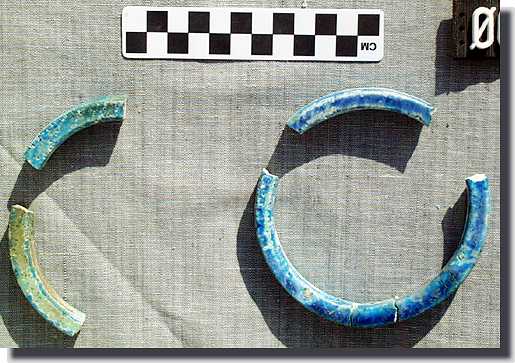
The picture to be built up of the Third Intermediate Period activity in TT99 is one of several phases of use. The evidence is uneven in its quantity; most of the non-coffin material just noted dates to the latest phases of use in the 25th and 26th dynasties, and the earlier occupations are clear only from coffin fragments. This tends to indicate that there is a strong possibility that the earlier burials were to some extent cleared out before the insertion of the later ones, but that there was perhaps little disturbance of the latest material until tomb-robbing began in earnest in the last 200 years. Tomb elementsTwo recesses in the north and south walls of the front room of the offering chapel must originally have contained one separately made false door and one stela, which have disappeared. Many fragments were recovered from the courtyard and the shafts in the courtyard which belong to a limestone stela and a granite false door. The name of Senneferi has been identified on several of the granite fragments, and thus these must have belonged to the false door of TT99; the badly broken and splintered nature of the fragments means that it is unlikely that it will be possible to reconstruct this object. No personal names have been noted on the stela fragments, but the quality of the carving and the style of the figures lead us to believe that these belong to the stela from TT99. These fragments have now been brought together and it is hoped that a photographic montage will enable some idea of the original form to be proposed. 11 It would appear that at the top of the stela was a scene of [Senneferi] before either Thutmose III or some deities, while one or more registers below included figures of relatives and dependants, all in fine raised relief. Below was a text in a number of horizontal lines of sunk relief. Post-pharaonicThis category covers a wide range of material, from Coptic to that which resulted from the habitation of the tomb. Here I simply mention that a considerable number of glass bracelet fragments were identified, which range from the plain blue with white prunts type of the Late Roman/Coptic period to more colourful ones which are mediaeval Islamic; 12 also found were many fragments of smoking pipes of Ottoman type, a common vestige of the recent reuse of the tombs. 13 These objects have all now been sorted and grouped logically, and work has begun on producing documentation for the publication, consisting of a combination of tracings, drawings and photographs. The material is being packed with a view to final storage when work on the tomb is completed. An eighth wooden box was obtained this year for this purpose. 3 Alan Clapham examined the funerary garland found in the 1994 season, and has made a number of provisional identifications of the component elements. His report is not to hand at the time of writing. 4Examples of both bracelets and beads in the Metropolitan Museum may be seen in W.C. Hayes, The Scepter of Egypt II (New York 1959), Fig. 100. 5I am indebted to René van Walsem of Leiden University (personal communication) for suggesting the interpretation of these objects adopted here. 6I wish to thank Dr Briant Bohleke of the Epigraphic Survey of the University of Chicago and Jiro Kondo of Waseda University for their comments on these texts. 7See for example that illustrated in F.D. Friedman, Gifts of the Nile. Ancient Egyptian Faience (Providence RI, 1998), 160 (Cat. 164). 8For example, from the Royal Cache: S. Spurr, N. Reeves and S. Quirke, Egyptian Art at Eton College (Windsor and New York 1999), 44 (Cat. 64). 9Such as ibid., 38-9 (Cats 51-4). 10Another, belonging to Wedjahor who was buried in TT99, is in Turin (Inv. 2470; my thanks to John H. Taylor for drawing this to my attention). 11Stelae in nearby tombs should provide parallels for reconstructions of part of this stela; see for example that in TT79 (H. Guksch, Die Gräber des Nacht-Min und des Men-cheper-Ra-seneb. Theben Nr. 87 und 79 (AV 34, Mainz 1995), 151-7) and that in TT97 (A.H. Gardiner, 'The tomb of Amenemhet, high-priest of Amon', ZÄS 47 (1910), 87-99). 12For comparable examples see C. Meyer in N. Strudwick, The tombs of Amenhotep, Khnummose and Amenmose (Oxford 1996), 136-7. 13Compare Strudwick, op. cit., 163, and the illustration in L. Kákosy, Dzsehutimesz sírja Thébában (Budapest 1989), 59. |
© Nigel Strudwick 1997-2018