|
Between October 15 and October 28, 103 textiles were examined. Technical aspects were recorded, including fibre, spinning direction, weave, dimension, thread count, selvedge type, and colour(s), as well as any sewing, thread, or decoration. The 103 pieces examined included 29 inscribed textiles, four plain textiles, 21 decorated textiles, 46 arbitrary samples of mummy wrappings, and three tassels. All samples of inscribed, plain, and decorated textiles had been humidified and relaxed by Julie Dawson. The 46 pieces of mummy wrappings were not so treated.
All 33 inscribed and plain textiles were made of linen. 31 had S-spun warp and weft, while two pieces had S-spun and Z-spun warp and weft. All pieces were constructed of tabby weave, ranging from simple to warp-faced. Weaves ranged from an open `net' weave with a thread count of 6 warp per cm by 4 weft per cm to a tight, closed weave with a thread count of 50 warp per cm by 30 weft per cm. Nine pieces had the remains of plain selvedges and one piece had a rolled hem secured by whipstitching. Twelve pieces had self-banded decoration. Fourteen pieces had warp-fringe, including simple, twisted, knotted, and braided fringes. Three pieces exhibited repairs, and two had identical maker's marks. One piece was dyed a light orange. There were several examples of thread splices.
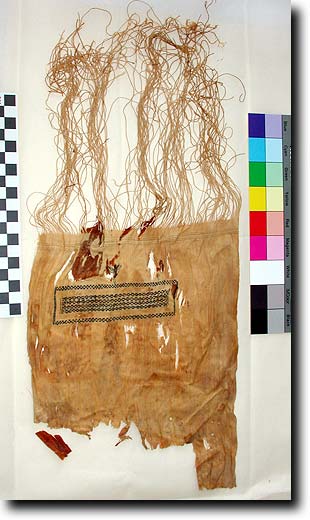
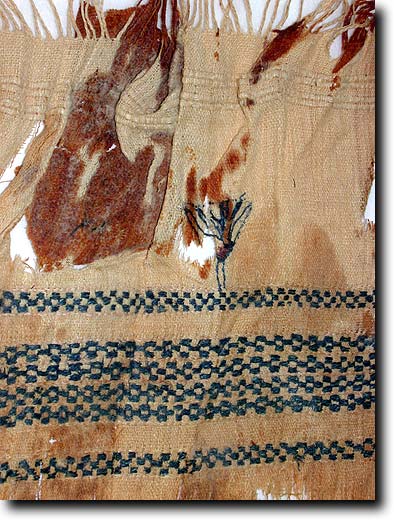
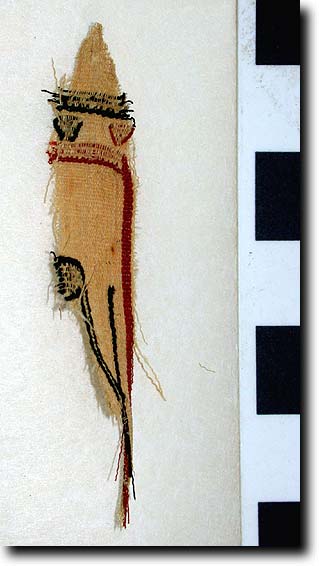
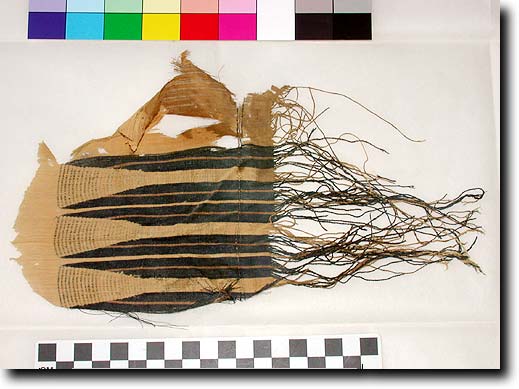
Twenty of the decorated textiles were linen with S-spun warp and weft; one piece was wool with Z-spun warp and weft. All pieces were constructed of tabby weave, ranging from simple to warp-faced. Weave structure ranged from loose, open weaves to tight, closed weaves. Thread counts ranged from 80 warps per cm x 40 wefts per cm to 16 warps per cm x 14 wefts per cm. There was no evidence of repair on any of the decorated textiles. A variety of decorations were present, including self-bands, stripes, and checks. Several designs were created by laying in supplemental warps and wefts during weaving, including a lotus flower under a box of checks (99.97.0502a: see photos 1 and 2 above)) and part of a stick figure (arm holding a staff--99.93.0873: see photo 3 above). Others included supplemental wefts being turned to become warp threads, an example being 99.94.1085 (cf see photo 4 above). Colours used in designs included shades of red, pink, blue, and black, with blue being the most frequently used colour. Several designs were outlined by rows of whipstitching. Thread was always S-spun and S-plied, and was usually 2 or 3-plied. Seven pieces had the remains of a plain selvedge. Seven pieces had warp fringe, including simple, braided, and twisted fringes.
Bags of linen from Shafts A, B, C (2 bags), D (2 bags), F, H, and I were arbitrarily chosen and five samples taken from each bag. One bag chosen consisted of fragments of a single, large object and so only one sample was recorded. All of the 46 samples were linen with S-spun warp and weft. Samples were variable from shaft to shaft, and in some cases, within a shaft. All were constructed of tabby weave, ranging from simple to warp-faced. Weave structure varied from delicate, loose, open weaves to tight, closed weaves. Thread counts ranged from 6 warps per cm x 3 wefts per cm to 60 warps per cm x 30 wefts per cm. Ten pieces had the remains of plain selvedges. Six had warp fringe, including simple, twisted, braided and knotted, and twisted and knotted fringes. Eight pieces had self-banded decoration, one had a single blue stripe. One piece exhibited a repair. One piece had a partial maker's mark, which seems to match the maker's mark noted on two pieces of flattened, plain linen.
|