Shaft H
In the 2000 season, a preliminary examination of bags of sherds from Shaft H showed that only the lowest levels of the shaft and the levels inside Room 2 were worth detailed study, since pottery from the upper shaft levels, and from Room 1 which was situated at a higher level within the shaft, were entirely disturbed in recent times. We had then begun to reconstruct some vessels from Room 2, and Gillian Pyke had drawn a number of these. During the current season, we were able to expand considerably on this work, and 64 drawings were made.
In contrast with the material from Shaft I, very few marl clay vessels were identified in the Shaft H assemblage. Just two amphorae were identified, both of which were uninscribed, and there were also two long-necked jars with bands incised on the shoulder. There was no evidence for the presence of other types of marl jar, nor of canopic equipment; whether these were originally present in the burial and had been looted, or whether they did not form part of the original funerary equipment, is unknown.
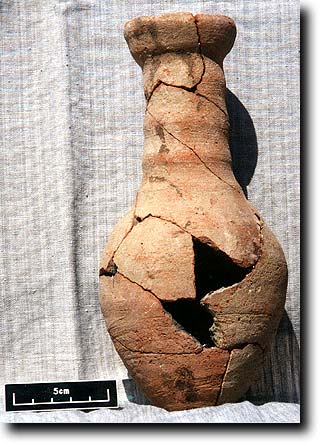
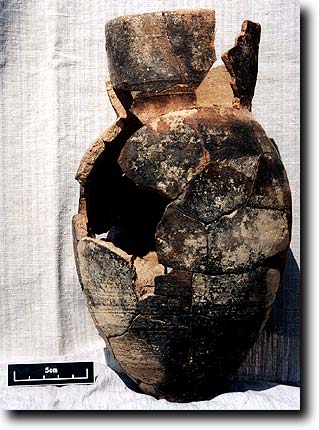
 In the siltware assemblage, the most striking feature was the number of wavy-necked jars. At least 18 such vessels came from the shaft and chamber, some of which were virtually complete, and others were represented by only one or two sherds. Almost all had banded decoration, in red, red and black, or red and blue on an uncoated or a cream or white coated surface; some of those decorated in red on white appear to have had both coating and stripes applied after the vessel was fired, unlike the more usual practice of applying decoration before firing. Fragments of one of these jars were also recovered from the courtyard pottery, and confirm that some of the material had been turned out of the shaft and chamber during looting.
The silt assemblage contained several other types. The most common were beer jars, represented principally by bases (which survive better than rims); there seem to have been at least 19 such vessels. Closed forms also included long-necked jars, similar in form to the marl clay vessels mentioned above, and biconical jars (see adjacent photo).  Fragments of one blue-painted vessel were recovered, but the design was too eroded to identify. Open forms consisted principally of small dishes and saucers. The dishes are often unslipped with red rim bands; dishes with out-turned rims were more often fully slipped. One point of interest was the frequency with which red paint was splashed over the surface of uncoated vessels; this was noted initially on open forms, and we assumed it to result from the careless application of a red rim band, but the same phenomenon was noted on the exterior of a long necked jar, suggesting that it is an intentional style of decoration. A further style noted was the addition of large roughly circular white dots to the interior of a red slipped dish, a method of decoration well-known at Deir el-Medina. Only one 'flowerpot' was identified, which again forms a striking contrast to the pottery from Shaft I.
Imports were rare, and consisted of three sherds of Canaanite amphorae, and the base of a base-ring ware vessel from Cyprus. There were too few body sherds of the amphorae to suggest that such jars originally formed part of the burial assemblage.
Although a very small quantity of post-Pharaonic material was identified in the lowest levels of the shaft and in Room 2, it appears that the majority of the pottery is homogenous in date. Parallels suggest a mid-18th dynasty date, later than that of the burial of Senneferi in Shaft I; the original burial in Room 2 may perhaps belong to one of Senneferi's descendants. As preserved, however, the ceramic assemblage appears far less rich and varied than that from Senneferi's burial.
Shaft F
The pottery from Shaft F had been examined briefly shortly after excavation in order to recover sherds of an early Roman amphora, large parts of which were present in the material. The sherds had never been quantified as to date, and this was undertaken this season. Pieces were also extracted for more detailed recording. Quantification showed that the shaft had been disturbed into recent times, since `modern' pottery was found throughout the deposits, and most of the sherds were either of modern or Late Roman date. The lowest levels of the shaft contained some Pharaonic sherds which clearly belong to vessels the bulk of which had come from the shafts situated in the rear chamber of the tomb. It was not possible to test these for actual joins, but the similarity is such that we can be confident that, as well as having their constituent sherds scattered between the five shafts in the rear room, sherds of the same vessels also found their way into the front chamber.
Some 27 fragments were drawn from this shaft, covering all periods.
Courtyard
The pottery from the courtyard was sampled, quantified and vessels selected for drawing in 1998. The material was found to comprise a mixture of predominantly modern and Late Roman pottery, with a smaller component of pharaonic pottery. No difference in proportions was detected between levels, and it seems that the material might have been dumped in the shafts and courtyard from elsewhere. 99 vessels from three squares were drawn in the 1998 season, all of Late Roman date. The Late Roman material consisted of local and imported amphorae, Aswan and silt fine wares and coarse-wares including cooking and storage vessels, and saqiya pots. In cases in which parallels could be found for these vessels, the suggested date range for this pottery is the sixth to seventh centuries ad .
Vessels from three further squares were drawn this season in order to have a representative sample of types from squares throughout the courtyard. A total of 32 vessels were drawn, the majority dating to the Late Roman period, but a few particularly interesting pharaonic and modern vessels were also drawn.