
Ceramics (Gillian Pyke and Pamela Rose)
The study of the pottery this season was carried out by Pamela Rose, Gillian Pyke and Amanda Dunsmore. Work concentrated on the ceramics from Shaft I, the burial place of the owner of the tomb, Senneferi, and there was sufficient time at the end of the season to make a brief examination of the pottery from a second shaft in the courtyard, Shaft H.
Shaft I
In 1999, Gillian Pyke, assisted by Nigel Strudwick and Inspector Abdel-Rahman Ahmed Hassan, made a good start on the reconstruction and recording of material from the shaft and associated chambers. This season saw the continuation of the process. As a result, every sherd has been examined, and the vast majority of the fragments have been attributed to specific vessel types. Furthermore, because so many of the fragments could be joined together, we are now able to make a relatively good assessment of the numbers of pottery vessels included in the burial, and it may be possible to suggest whereabouts in the underground chambers the vessels were originally located.
The most interesting group of vessels were of marl clay fabrics. These included the four inscribed canopic jars, along with substantial parts of two of the lids, modelled to represent human heads (one is shown here). 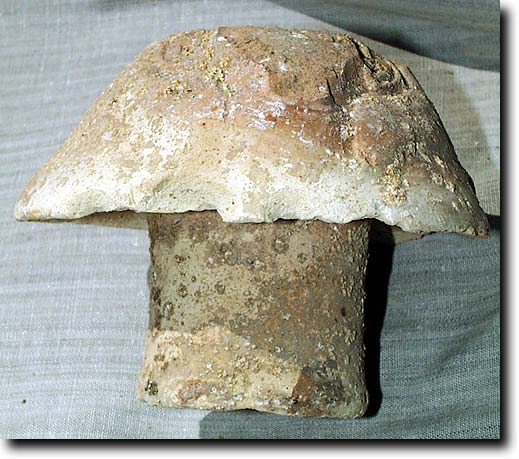 Given the relative completeness of most of the other pottery, the absence of the remaining lids is surprising, and it is possible that they were removed as 'collectables' during earlier probings of the shaft. An interesting feature of the lids is that the two are made using strikingly different manufacturing techniques. Other forms include three loop-handled jugs, eight one-handled jugs, five pilgrim flasks, at least four bottles and up to seven jars. Almost all of these are made out of clay of Upper Egyptian origin, with only one vessel coming from further afield in Lower Egypt. The jugs, flasks, bottles and some of the jars were decorated in black or black and red with simple linear and spot motifs. Many preserved traces of the original method of closure of the vessel mouth, using reeds and cloth. Many of the vessels were inscribed giving their contents.
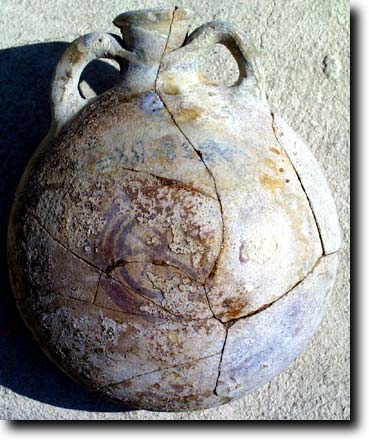 Much time this season was devoted to the reconstruction of a group of amphorae with a distinctive fabric. Six such vessels, closely similar in shape and size, were eventually put together. The fabric indicates that the vessels may have originated in the western oases of Egypt, rather than the Nile valley. Four of the vessels were inscribed, and two had had oval stamps impressed into their shoulders before firing. One of these can be read 'Menkheperre'. The ink inscriptions include references to commodities stored therein and include year dates, but their study is not yet complete; the presence of a reference to a 'year 38' on a pilgrim flask from the burial should however confirm the dating to the reign of Tuthmosis III (see picture, and below). The vessels do not preserve certain indications of the method of closure, but one had a line of mud around the shoulder which may indicate the original presence of a seal. However, none of the others showed any similar traces.
From further afield was a group of small vessels, which probably originated in Cyprus. They included two base-ring ware juglets, and a juglet and pilgrim flask of burnished red ware.
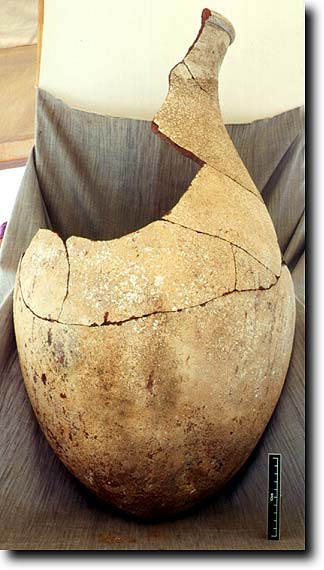 The other major effort of reconstruction this season was on the many sherds of large siltware jars found in Room 3 of Shaft I, assumed to be the burial chamber of Senneferi. These jars, some 70 cm tall and with a maximum diameter of about 40 cm, had wheel-made necks and handmade bodies, and proved extremely difficult to put together. Eventually the necks of 21 jars were rebuilt, but only one vessel could be reconstructed from base to rim. None was inscribed, and there is no surviving indication that the vessel mouths were originally sealed. It is interesting to consider that this type of vessel alone would have taken up almost half the available space in Room 3 of Shaft I if placed upright therein.
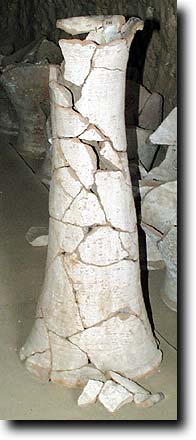 Other siltware vessels were less easy to reconstruct, since the softer nature of their fabric had led to more damage and wear. Types certainly present included 'flowerpots', deep bowls with flaring sides and a hole made through the base before the vessels were fired. There were at least 20 of these, and it is possible that, rather than serve as containers, they acted as covers for the large siltware jars discussed above. This however is speculative. The most common siltware forms were shallow dishes and bowls, fragments of a large number of which were preserved. Jars were less common, and often represented by only a few identifiable sherds. A final, wholly reconstructable vessel was a tall trumpet-form offering stand.
Almost all of the pottery from Shaft I is of types well-known from the earlier mid-18th dynasty, and the year date and stamp both suggest strongly that it belongs to the reign of Tuthmosis III, in whose reign Senneferi presumably died. There is very little pottery of a recognisably intrusive nature. Most pieces which are definitely later in date come from close to the point at which the shaft proper enters the underground complex and reflect accidental additions to the complex. The presence of only four canopic jars may suggest that there was only one burial made in the chambers.
At the end of the season there was time to begin to record and draw the pottery from another shaft in the courtyard of tt 99, shaft H. Here the material could be divided into two groups. That from the lower shaft fill and from room 2 was mainly Pharaonic in date, whereas that from room 1 represented disturbance up until recent times. It is likely that robbers dug down one side of the shaft, and as a result discovered only one of the chambers running from it.
The pottery from room 2 can be dated to the 18th dynasty, but is certainly a little later in date that the pottery from Shaft I since it includes vessels using simple blue-painted banded decoration. The types present are far less in number than those from Shaft I, and are exotic in types; there are few marl clays, no imports and no canopic jars. Rather, the majority of vessels are of siltware. They include at least six decorated wavy-necked bottles of various sizes, a blue-painted jar and a biconical jar, as well as many 'beer jars'. There is no evidence for the presence of large siltware jars or flowerpots such as were found in Shaft I.
Study of this material is not yet finished, and it is hoped that further study will enable a more precise date to be established for it.
The Mission was fortunate that it was possible for Dr Briant Bohleke of Chicago House to make a brief visit at the end of the season and re-examine the sherds which bear hieratic inscriptions. The impressive results of the reassembly of vessels noted above meant that many improved readings were obtained. The following is his summary report:
The hieratic dockets on pottery from tt 99 fall into general categories of the following types:
'Good edibles for consumption': despite this label being commonly found on pottery in New Kingdom burials, the particular contents of the vessels remain unknown and hence the generalized translation.
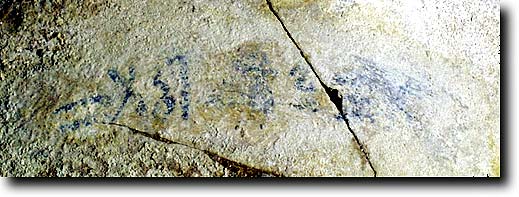 'Good wine for the new year': this label is found exclusively on the so-called Pilgrim flasks. An important variant found in TT99 is 'good wine for Year 38', which provides a terminus post quem in the reign of Thutmose III (due to the high date) for Senneferi's burial.
Oasis ware was used for varying products, both food and drink. The solid product is 'earth almonds' (popularly known in English as 'tigernuts'), after which it appears that a quantity may have been given. The wine is of two types, 'wine of the vineyard' and 'wine of the warrior', which is perhaps that of a specific vineyard.
Oasis ware vessels also preserve dockets with regnal years 25 and 28 on them, and one bears the stamp of Thutmose III's throne name.
The only sign on one sherd is Hry , most likely the beginning of the title 'chief vintner'. It is to be regretted that the man's name is not forthcoming.
Contexts outside the burial apartments of Senneferi in TT 99 yielded seven ostraca whose palaeography indicates a later date of composition. Their fragmentary nature make them difficult to transcribe, but they seem to be tallies and accounts. The most legible list enumerates a few products and includes their quantity or value. Among these are a stick of sycamore, a goat, grain, and one other commodity, of which there were 13.5.
© Nigel Strudwick 1997-2018